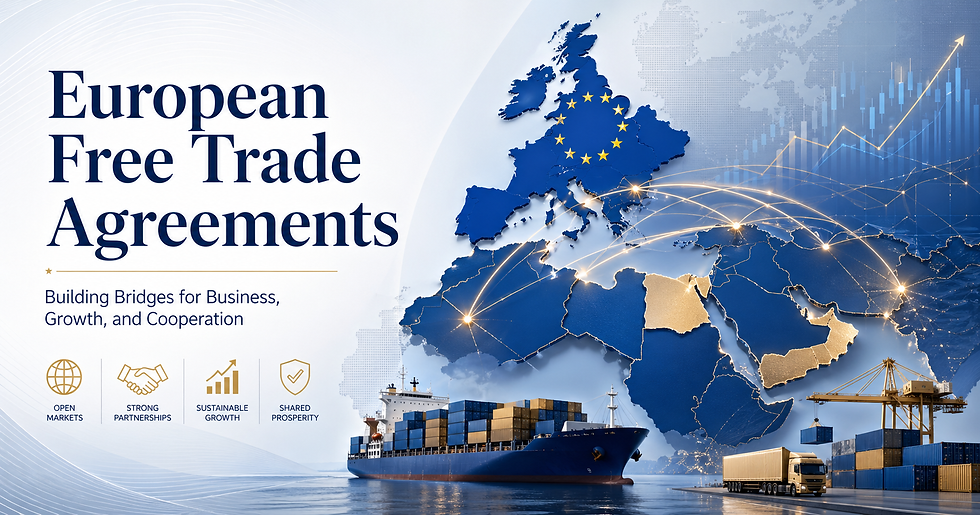
European Free Trade Agreements: Building Bridges for Business, Growth, and Cooperation
How European FTAs support international trade and create new opportunities for Euro-Arab economic relations
European Free Trade Agreements, often called FTAs, are important tools for building stronger economic relations between countries and regions. They help reduce trade barriers, support business cooperation, and make it easier for companies to exchange goods, services, knowledge, and investment. For the Euro-Arab business community, European FTAs can open new doors for partnership, innovation, and long-term growth.
A free trade agreement is a formal agreement between two or more economies. Its main goal is to make trade easier by reducing or removing customs duties, simplifying rules, and improving market access. These agreements can cover many areas, including goods, services, public procurement, investment, intellectual property, digital trade, competition, and sustainable development.
Europe has a strong tradition of trade cooperation. The European Union has developed many trade agreements with partners around the world, while the European Free Trade Association, known as EFTA, also plays an important role. EFTA includes Iceland, Liechtenstein, Norway, and Switzerland, and it was created to promote free trade and economic integration. Today, EFTA has a wide global network of free trade agreements with countries and territories outside the European Union.
For businesses, FTAs can bring several practical benefits. Lower customs duties can reduce costs. Clearer trade rules can help companies plan with more confidence. Simplified procedures can make import and export faster. Better access to foreign markets can support small and medium-sized enterprises, not only large companies. In this way, FTAs can help businesses become more competitive and more internationally connected.
European FTAs are also valuable because they often include modern standards. Many agreements now address sustainability, responsible business conduct, labour principles, environmental protection, transparency, and fair competition. This makes trade not only easier, but also more reliable and future-oriented. For companies in Europe and the Arab world, this creates a positive environment for partnerships based on trust, quality, and shared responsibility.
The Euro-Arab region has many natural areas of cooperation. Arab markets have strong potential in energy, logistics, tourism, infrastructure, food security, digital services, education, finance, and investment. European markets are known for advanced technology, quality standards, industrial expertise, research, and strong regulatory systems. When trade agreements reduce barriers and improve cooperation, both sides can benefit from more balanced and productive economic relations.
One important example is the Free Trade Agreement between the Gulf Cooperation Council and EFTA states, signed in 2009. According to the UAE Ministry of Economy and Tourism, the agreement covers areas such as trade in goods, trade in services, government procurement, intellectual property rights, administration, dispute settlement, and competition. This shows how European trade frameworks can connect directly with Arab economies and support wider cooperation.
Free trade agreements can also encourage investment. When companies know that trade rules are stable and transparent, they may feel more confident about entering new markets, opening branches, forming joint ventures, or building supply chains. This is especially important in a changing global economy, where companies want secure routes, trusted partners, and flexible access to different regions.
For chambers of commerce, FTAs are not only legal documents. They are practical platforms for business development. Chambers can help companies understand the opportunities created by these agreements, explain customs and documentation requirements, connect exporters and importers, and support business missions between regions. This role is especially important for small and medium-sized companies that may not have large legal or international trade departments.
European FTAs also support knowledge exchange. Trade today is not only about products moving across borders. It is also about services, technology, training, digital solutions, and professional expertise. In this sense, Euro-Arab cooperation can grow through education partnerships, consulting services, green technologies, financial services, healthcare innovation, and digital transformation.
However, businesses should also understand that every FTA has its own rules. Companies usually need to check rules of origin, product standards, customs procedures, certification requirements, and sector-specific conditions. A free trade agreement can create opportunities, but companies must use it correctly. Professional advice, chamber support, and careful planning are important for turning trade agreements into real business success.
Looking ahead, European FTAs are likely to remain important for global commerce. As supply chains become more complex and markets become more connected, countries need trade systems that are open, clear, and responsible. For the Euro-Arab business community, this creates a positive opportunity to strengthen cooperation between Europe and the Arab world in a structured and sustainable way.
In conclusion, European free trade agreements are more than trade policy. They are bridges between economies, companies, and people. They can reduce barriers, support investment, encourage innovation, and create stronger business relationships. For the EACC Euro-Arab Chamber of Commerce, the topic of European FTAs is especially relevant because it reflects the future of international cooperation: open markets, trusted partnerships, and shared economic progress.


Comments